Dixon Water Foundation

Promoting healthy watersheds through sustainable land management

  • About Us
    • Strategic Plan
    • About Us
    • Staff
    • Board of Directors
    • Annual Reports
    • Ecosystem Service Resources
  • Ranches
    • Sustainable land management
    • Leo and Pittman Units
    • Mimms Unit
      • Grass-finished Beef Program
      • Mimms Unit Motus – Wildlife Tracking Station
    • Josey Pavilion
    • Alamito Creek Preserve
  • Grants
  • Education
    • School Partnerships
    • Landowner Education
    • Media Projects
    • Field Days
  • Research
    • Research Projects
    • Resources
    • In-House Monitoring (Vegetation Communities)
  • News & Events
    • Recent News
    • Events
    • In The Media
    • Press Releases
  • Contact

Walt Davis on educating ranch managers

April 24, 2015 by Administrator

Walt Davis, a fifth-generation rancher and Dixon Water Foundation board member, was recently asked what should be included in a ranch management curriculum. The foundation supports sustainable ranching programs at Sul Ross State University and North Central Texas College, which are training a new generation land stewards who should understand the concepts Mr. Davis stated so well:

“The first bit of knowledge that I would suggest as critical to ranch managers is that all agriculture— ranching included—is a biological, rather than an industrial, process. The ranch most likely to be both profitable and sustainable will be the one that best mimics the complex web of relationships between soils, vegetation, grazers and predators that nature has used to create the productive and stable grassland communities that existed in various parts of the world prior to human intervention.

This program of natural management evolved over eons of time and is based in the fact that anything that is detrimental—in the long run—to any part of a functioning system is harmful to the entire system. It does not produce the most pounds per acre of animal life or the most pounds of grass, but rather a system that is highly resilient and effective in converting solar energy into biological energy over long periods of time.

The closer we can keep our management to this model, the more apt we are to build ranches that are ecologically, financially and sociologically sound. The major difference should be that humans assume the role of primary predator. This allows humans to benefit—take subsistence and create wealth—but it also means that we must take on the functions performed by predators: control numbers to suit conditions (set stocking rates); prevent abusive grazing (keep animals concentrated and moving); and maintain genetic fitness in the grazing animals by selection and culling.

A second concept of value would be the importance of biodiversity in improving the health of soils, plants, animals and bank accounts. Every type of organism has needs and the abilities to provide for those needs that are different from those of even its closest relatives. Having a broad range of healthy populations—made up of healthy individuals—of different kinds of organisms insures that no one species increases in number to pest status and that the resources of sunlight, water, mineral nutrients and space are fully utilized with none being over-utilized. Weeds and brush proliferate because the local environment is degraded and ecological niches are not being filled. Most weed and brush control methods make the situation worse by further simplifying the environment. We should manage for what we want; not against what we don’t want.

Stockmanship is a skill of vast importance that is woefully lacking on many ranches. We create most animal health problems by stressing the animals.

Finally, the importance of and the rationale behind planned, time-controlled grazing. This must include getting in sync with the realities of climate, vegetation, water, and the use of adapted animals. Basic to successful grazing management is an understanding of the relationships between grasslands and grazing animals and that proper grazing builds grassland health.

Many of the problems of ranching originated with the shift of emphasis from husbandry to science. We must use science to understand nature, but it is a mistake to attempt to use science to control nature. There is a severe shortage of people who understand that we must promote the health of the whole animal-plant-soil-human-wealth complex we call a ranch, in order to create profitable and sustainable operations.”

Walt Davis writes regular columns for the Farm Progress family of magazines and other publications. He has published two books: How to Not Go Broke Ranching and A Gathering At Oak Creek and has three others under way. You can learn more about his work at waltdavisranch.com.

Filed Under: Recent News Tagged With: education, ranching

Land-use change in the Trans-Pecos

March 25, 2015 by Administrator

GoingGoneNewsWebsitefull

Texas’s water supply depends heavily on the stewardship of private agricultural land, which is increasingly being fragmented and developed. Learn more about changing land use in the Trans-Pecos and tools for private lands conservation at an upcoming seminar, “Going, Going, Gone!” on April 30th in Alpine. To learn more and register, visit the Texas Agricultural Land Trust website.

Filed Under: Events Tagged With: education, ranching

Gainesville Daily Register features foundation’s TEEA award

March 14, 2015 by Administrator

The Dixon Water Foundation’s Texas Environmental Excellence Award was featured in the Gainesville Daily Register.

“We’re deeply honored to be recognized by TCEQ and the governor’s office,” said Robert Potts, the foundation’s president and CEO in the article by Kit Chase. “We are thankful for all of the hard-working people and collaborative partnerships that make our ranches, as well as our grant and education programs, successful. And we hope this recognition sparks more interest in the sustainable grazing practices we demonstrate on our land.”

Filed Under: In The Media Tagged With: awards, education, ranching, research

Talking Dirty: soil health workshop Mar. 20-21

January 25, 2015 by Administrator

If you consider yourself a gardener, farmer, rancher or landscape architect, think again.

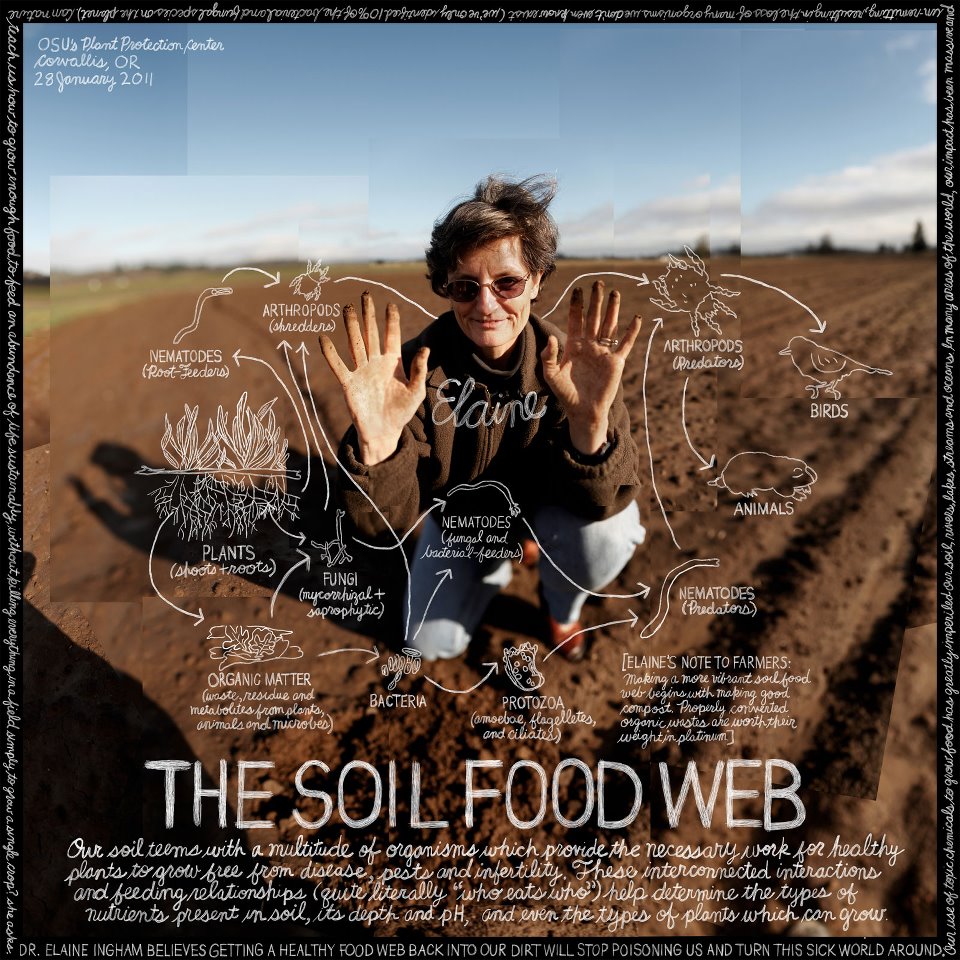
“Instead, you are a soil manager,” says Dr. Elaine Ingham, who will be giving a workshop and free lecture on soil health March 20-21 at Cedar Valley College in Lancaster.

Ingham is a leading soil microbiologist, composting guru, and former chief scientist of the organic-farming icon, The Rodale Institute. Whether your soil is growing tomatoes in an urban backyard or cattle forage in a pasture, Ingham offers practical knowledge about how to make soils and plants flourish without synthetic chemicals.

The free lecture on Friday, “Talking Dirty Soil Solutions,” provides an introduction to the soil food web—the complex system of microorganisms that create and sustain healthy, fertile soil. The lecture will be held in the Cedar Valley College gym from 9am to 10am.

A full-day workshop on Saturday delves deeper into the soil food web, compost, and compost tea technology. Ingham will explain the elements of a thriving soil food web, teach participants how to analyze and improve soil, and demonstrate how to make composts and organic extracts to strengthen the soil food web. This workshop costs $99 and will be held from 9am to 5pm in Cedar Valley College rooms M121-M122.

Ingham will share more of her wisdom during a benefit dinner on Thursday, March 19, at the Farm Girls’ Waxahachie classroom. Live music by Justin Smith and a farm-to-table banquet prepared by Chef Amy, co-owner of Field to Meal, will raise funds to provide free workshop passes for agricultural producers. The festivities start at 7pm and the requested donation is $65 to $150. To reserve a spot at the banquet, visit https://www.eventbrite.com/e/farm-to-fork-dinner-benefitting-farmers-tickets-15826384141

For more information, to register, or to nominate a producer for a free workshop pass, visit carboneconomyseries.com or call (469) 554-9202. The lecture and workshop are presented by the Carbon Economy Series, in partnership with the Dixon Water Foundation.

Elaine

Filed Under: Events, Press Releases Tagged With: education, soil

Soil Health Conference in Fort Worth on Jan. 13 & 14

December 5, 2014 by Administrator

soilhealthconference_web

Green Cover Seed will be hosting the Southern Soil Health Conference, an Educational Opportunity for Producers and Land Owners, in Fort Worth on January 13 and 14, 2015.

The Dixon Water Foundation is one of several organizations sponsoring the conference: Samuel Roberts Noble Foundation, Texas Grazing Land Conservation Initiative, No-Till on the Plains, Sand County Foundation, Out On The Land, and Natural Resources Defense Council.

This unique conference will focus solely on the Five Keys to Soil Health: Keep the Soil Covered; Minimize Soil Disturbance; Crop Diversity; Living Roots in Soil at all times; and Integration of Livestock with the Land. This conference is for producers and land owners, 75% of the registration slots will be reserved for people directly involved with the land: production agriculture (crops and/or livestock) and land owners. This conference will also be producer driven with almost all the speakers and presenters being farmers. Keynote speakers will include; Gabe Brown, Scott Ravenkamp, Robin and Kelly Griffeth, and Paul Jasa. In addition, we will have 8-10 Texas and Oklahoma producers sharing about their individual experiences with Soil Health and how it has affected their farming operations. Some of these speakers are Todd Kimbrell, Terry McAllister, Jonathan Cobb,and Lisa Bellows. And this conference is about knowledge and learning and not selling products. We will not be having a commercial trade show to promote individual companies or products.

To register or learn more, visit Green Cover Seed’s conference website.

Location:
Best Western Plus South
100 Altamesa Boulevard E
Fort Worth, Texas, 76134
Phone: 817.293.3088

Date: January 13th & 14th, 2015

Cost: $100 Per Person – Your Spouse can register for $50**

*NOTICE – The cost of registration DOES NOT reserve your hotel room. You must book and cover the cost of your hotel room on your own. To reserve your room at the Best Western Plus, contact the hotel (information listed above) and be sure and mention Southern Soil Health Conference when you are booking your room to get the discounted rate of $69 per night.


Filed Under: Events Tagged With: education, grasslands, ranching, soil

Dixon presents Sul Ross check for sustainable ranching program

September 6, 2014 by Administrator

Officers of the Dixon Water Foundation presented a $200,000 check to Sul Ross State University on Tuesday, Sept. 2. The check represents the first of six annual $200,000 increments to fund the creation of both a B.S. degree and a certificate program in sustainable ranch management at Sul Ross, as well as a permanent endowment for the Clint Josey Chair of Sustainable Ranch Management. The check presentation was featured on NewsWest9.

Pictured (from left) are: Dr. Robert Kinucan, Dean of the College of Agricultural and Natural Resource Sciences; Robert Potts, DWF President and CEO; Melissa Bookout, DWF secretary-treasurer and Education Program director; Clint Josey, Vice President and Chairman of the Board; Dr. Bonnie Warnock, professor of Natural Resource Management, who will be the program’s endowed professor; and Sul Ross President Dr. Bill Kibler. Warnock is developing a curriculum this year, with the first students to be enrolled in the program in fall 2015. (Photo by Steve Lang/Sul Ross State University)

Filed Under: Recent News Tagged With: education, ranching

Josey Agroecology Institute in Lewisville Leader

August 12, 2014 by Administrator

On August 12, the Lewisville Leader featured the Josey Agroecology Institute at North Central Texas College, funded by a grant from the foundation.

nctc-grant-lg

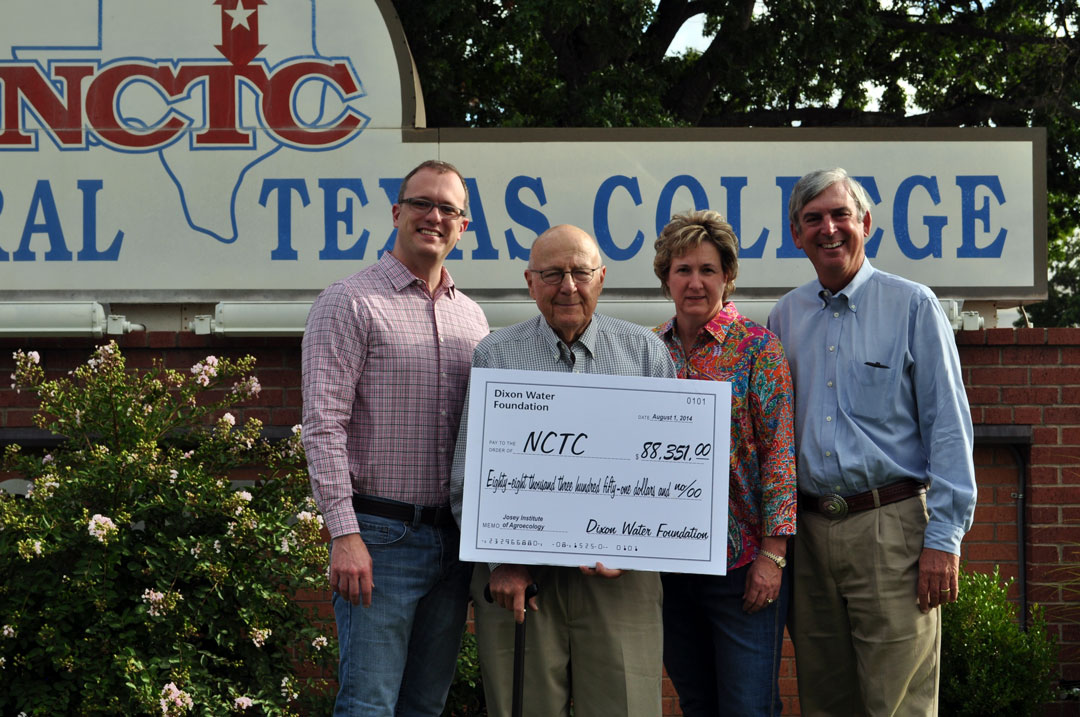
Clint Josey (second from left), the Chairman of the Board of Directors of the Dixon Water Foundation, presents a check to NCTC officials to establish the Josey Institute of Agroecology. Also pictured is NCTC President Dr. Brent Wallace (left), NCTC Science and Math Initiatives Chair Dr. Lisa Bellows, and Dixon Water Foundation CEO Robert Potts.

Filed Under: In The Media Tagged With: education, grants, research

Dixon funds agroecology institute at NCTC

August 8, 2014 by Administrator

GAINESVILLE―A new institute at North Central Texas College will promote sustainable agriculture and healthy food production.

The Josey Institute for Agroecology will conduct research and offer educational programs on sustainable ranching and farming for NCTC students, as well as land owners and the general public. The institute’s creation was funded through an $88,000 grant from the Dixon Water Foundation, which promotes healthy watersheds through sustainable land management and has two ranches in Cooke County.

“This institute will help train a new generation of land stewards to manage economically and ecologically sustainable ranches, which are so important to our state’s future,” said Robert J. Potts, president and CEO of the Dixon Water Foundation.

Receiving the foundation’s check on his first day as NCTC president, Dr. Brent Wallace said, “Service to the community is a vital part of our mission. The establishment of the Josey Institute at NCTC is going to allow us to explore some innovative approaches in serving our students, as well as the entire community, by including programs for planetary sustainability. We are extremely grateful for the monetary contribution, but even more honored to have the opportunity to work in partnership with the people at Dixon Water Foundation.”

Science professor Lisa Bellows will direct the institute. “This will be an exploratory year for the Josey Institute, so that we can define the needs of our community, organize our approach, and target the position of NCTC as a leader in agricultural ecology,” Bellows said.

The institute will serve as the new home of the Promoting Agriculture and Conservation Education (PACE) Project, an existing collaboration between the college and the Gainesville Independent School District. PACE students learn about sustainable ranching on a holistically managed property south of the Gainesville High School. Rotational and multi-species grazing are demonstrated on the property, which is owned by the school district and leased by the college. The Dixon Water Foundation has previously funded the PACE Project as well.

The PACE Project has offered several programs for agriculturalists in the past three years. Bellows said, “Internationally recognized soil microbiologist Dr. Elaine Ingham attracted over 180 visitors to our campus, and we provided soil micro training for over 100 participants this past year.”

Through the institute, Bellows will be teaching a Sustainable Agriculture course this fall, in which Whole Land Management will be the focus. The institute has also scheduled several programs for the general public in the coming year.

The Dixon Water Foundation’s mission is promoting healthy watersheds through sustainable land management. To that end, the foundation demonstrates sustainable land management practices at its four ranches in north and west Texas. In Cooke County, the foundation’s Leo ranch is the site of the new Betty and Clint Josey Pavilion, which aims to be Texas’ first Living Building, the highest standard in sustainable building. The foundation also hosts educational programs, partners with researchers, and funds grants for projects that further its mission.

nctc-grant-lg

Dixon Water Foundation board chairman Clint Josey presented the check for the Josey Institute of Agroecology to NCTC on August 1. From left to right: Dr. Brent Wallace, president of NCTC; Mr. Josey; Dr. Lisa Bellows; and foundation President and CEO Robert Potts.

Filed Under: Press Releases, Recent News Tagged With: education, grants, Holistic Management, ranching

Wildflower tours at Bear Creek and Pittman ranches in May

April 11, 2014 by Administrator

The Nature Conservancy’s Jim Eidson will be leading wildflower tours at Bear Creek Unit on May 4, and at Pittman Unit on May 24. Visit the Native Prairies Association website for more information about the Pittman tour, and this Facebook post to learn more about the Bear Creek tour.

Filed Under: Events Tagged With: Bear Creek Unit, education, field program, Pittman Unit

Odessa American reports “Good News” of Dixon endowment at Sul Ross

March 14, 2014 by Administrator

Odessa’s newspaper featured the Dixon Water Foundation’s endowment at Sul Ross State University. The $1.2-million gift will fund the creation of a new degree program in sustainable ranch management.

Filed Under: In The Media Tagged With: education, ranching

« Previous Page
Next Page »

OUR MISSION

The Dixon Water Foundation promotes healthy watersheds through sustainable land management to ensure that future generations have the water resources they need.
https://youtu.be/WdtvsHgsnPo

NORTH TEXAS OFFICE

4528 County Road 398
Decatur, TX 76234

WEST TEXAS OFFICE

P.O. Box 177
Marfa, TX 79843

STAY IN TOUCH

  • Email
  • Facebook
  • Instagram

SEARCH

Copyright © 2026 · Outreach Pro on Genesis Framework · WordPress · Log in