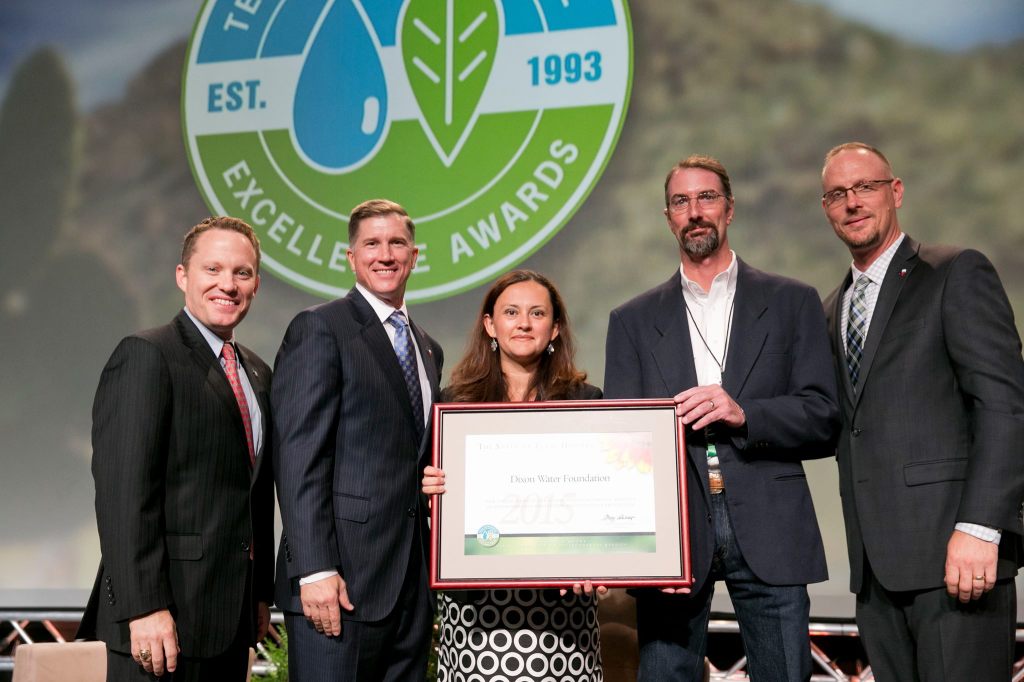
 The Dixon Water Foundation was honored with a Texas Environmental Excellence Award in Agriculture at the TCEQ’s Environmental Trade Fair and Conference in Austin last week. Ranch manager Casey Wade and board member Leslie Rauscher were on hand to accept the award. TCEQ produced this video about the foundation’s work for the ceremony:
RECENT NEWS
Walt Davis on educating ranch managers
Walt Davis, a fifth-generation rancher and Dixon Water Foundation board member, was recently asked what should be included in a ranch management curriculum. The foundation supports sustainable ranching programs at Sul Ross State University and North Central Texas College, which are training a new generation land stewards who should understand the concepts Mr. Davis stated so well:
“The first bit of knowledge that I would suggest as critical to ranch managers is that all agriculture— ranching included—is a biological, rather than an industrial, process. The ranch most likely to be both profitable and sustainable will be the one that best mimics the complex web of relationships between soils, vegetation, grazers and predators that nature has used to create the productive and stable grassland communities that existed in various parts of the world prior to human intervention.
This program of natural management evolved over eons of time and is based in the fact that anything that is detrimental—in the long run—to any part of a functioning system is harmful to the entire system. It does not produce the most pounds per acre of animal life or the most pounds of grass, but rather a system that is highly resilient and effective in converting solar energy into biological energy over long periods of time.
The closer we can keep our management to this model, the more apt we are to build ranches that are ecologically, financially and sociologically sound. The major difference should be that humans assume the role of primary predator. This allows humans to benefit—take subsistence and create wealth—but it also means that we must take on the functions performed by predators: control numbers to suit conditions (set stocking rates); prevent abusive grazing (keep animals concentrated and moving); and maintain genetic fitness in the grazing animals by selection and culling.
A second concept of value would be the importance of biodiversity in improving the health of soils, plants, animals and bank accounts. Every type of organism has needs and the abilities to provide for those needs that are different from those of even its closest relatives. Having a broad range of healthy populations—made up of healthy individuals—of different kinds of organisms insures that no one species increases in number to pest status and that the resources of sunlight, water, mineral nutrients and space are fully utilized with none being over-utilized. Weeds and brush proliferate because the local environment is degraded and ecological niches are not being filled. Most weed and brush control methods make the situation worse by further simplifying the environment. We should manage for what we want; not against what we don’t want.
Stockmanship is a skill of vast importance that is woefully lacking on many ranches. We create most animal health problems by stressing the animals.
Finally, the importance of and the rationale behind planned, time-controlled grazing. This must include getting in sync with the realities of climate, vegetation, water, and the use of adapted animals. Basic to successful grazing management is an understanding of the relationships between grasslands and grazing animals and that proper grazing builds grassland health.
Many of the problems of ranching originated with the shift of emphasis from husbandry to science. We must use science to understand nature, but it is a mistake to attempt to use science to control nature. There is a severe shortage of people who understand that we must promote the health of the whole animal-plant-soil-human-wealth complex we call a ranch, in order to create profitable and sustainable operations.”
Walt Davis writes regular columns for the Farm Progress family of magazines and other publications. He has published two books: How to Not Go Broke Ranching and A Gathering At Oak Creek and has three others under way. You can learn more about his work at waltdavisranch.com.
Foundation receives Texas’s highest environmental honor
The Texas Commission on Environmental Quality this week honored the Dixon Water Foundation with a Texas Environmental Excellence Award in Agriculture, the highest environmental honor in the state. These prestigious awards bring attention to the most innovative and effective projects that strive to protect the state’s natural resources.
“With a patient and consistent dedication to holistic land management, the Dixon Water Foundation is assuring the most free and open lands in the state can remain healthy and productive for future generations,” says TCEQ’s announcement. Read more about the foundation’s award on the TEEA website or in this article by the Gainesville Daily Register.
Can grazing restore ecosystems?
A new Arizona State University research team is examining the benefits of adaptive multi-paddock grazing, the type of management used on Dixon Ranches.
“By using measures—such as the carbon stored, the water absorbed and retained, populations of fungi, bacteria, wild life and insects, and rancher and animal well-being—we are comparing adaptive grazing with conventional grazing to see if the former actually improves ranch ecosystems,” said Peter Byck, professor of practice at ASU and director, producer and writer of the documentary Carbon Nation. “We hope to study and compare 36 ranches located in four diverse eco-regions across the U.S. and southern Canada.”
Also on the ASU research team is Richard Teague, a Dixon Water Foundation advisory board member and Associate Resident Director and Professor with Texas A&M AgriLife Research. The team is presenting their research at the American Association for the Advancement of Science’s annual meeting this week.
Read more about the research project at: http://phys.org/news/2015-02-capturing-carbon-soil-real-scale.html#jCp
Research shows planned grazing restores grassland at TomKat Ranch
Carefully planned grazing can increase native grasses and restore grassland overtaken by exotics, according to recent research at the TomKat Ranch in California. Like Dixon Ranches, TomKat Ranch practices Holistic Management.
From an article about the grazing study in Conservation magazine:
According to the experimental paradigm, the density of cattle was increased by subdividing the grazing area into sub-units. The cattle were allowed to graze in one area for a specified period of time (between one day and one week), and were then shifted to the next area. Each paddock therefore received between 70 and 120 days of rest in between grazing periods. This went on for two years. In July of 2011, 2012, and 2013, the researchers surveyed for native grasses.
The proportion of “vegetation survey units” that included native grasses at all increased from 8% in 2011 to 80% in 2013. The surface area covered by native grasses remained small throughout the study (less than 5%), but increased significantly over time. In 2011, the researchers spotted only single, dispersed, individual grasses from among the native species. By 2013, they found a number of small but dense patches, each containing multiple individuals.
The gains made by the native grasses were meager, but promising. The results convincingly suggest that switching from season-long open-ended continuous grazing to a more rigorous planned schedule will facilitate the restoration of California’s grassland.
This short video from NBC Bay Area explains more about the research, which was published in Ecological Restoration.
Josey Pavilion wins AIA Honor Award
The Betty and Clint Josey Pavilion received an Honor Award at the 2014 AIA San Antonio Design Awards last week. Designed by Lake|Flato Architects, the pavilion was featured in an article about the awards on The Rivard Report.