How did the Rock House Fire and 2011 drought affect soil microbes at Mimms Unit? That was the subject of a recent research project by Masahiro Ohnishi, a Natural Resource Management graduate student at Sul Ross State University in Alpine. The Dixon Water Foundation funded Ohnishi’s research, which was featured in “The Road to Recovery” in the July 2013 issue of Texas Wildlife, republished here with permission of the Texas Wildlife Association. Ohnishi’s research was featured previously in the May 16, 2013 issue of the Big Bend Sentinel.
Soil still teems with life after fire, SRSU student finds
MARFA – Two years ago, the Rock House Fire and a record drought scorched most of the Dixon Water Foundation’s Mimms Ranch outside Marfa. The effects aboveground are still obvious, where grasslands are punctuated by patches of barren earth. But how did the fire and drought affect microbes toiling in the soil to create the nutrients grasslands require? This subterranean recovery was studied recently by Masahiro Ohnishi, a Natural Resource Management graduate student at Sul Ross State University in Alpine.
“We wanted to see what kinds of bacteria and archaea are in the soil after the fire and after the drought, and how they recovered from these huge disturbances,” says Ohnishi, whose research was funded by the Dixon Water Foundation, a non-profit that promotes healthy watersheds through sustainable land management.
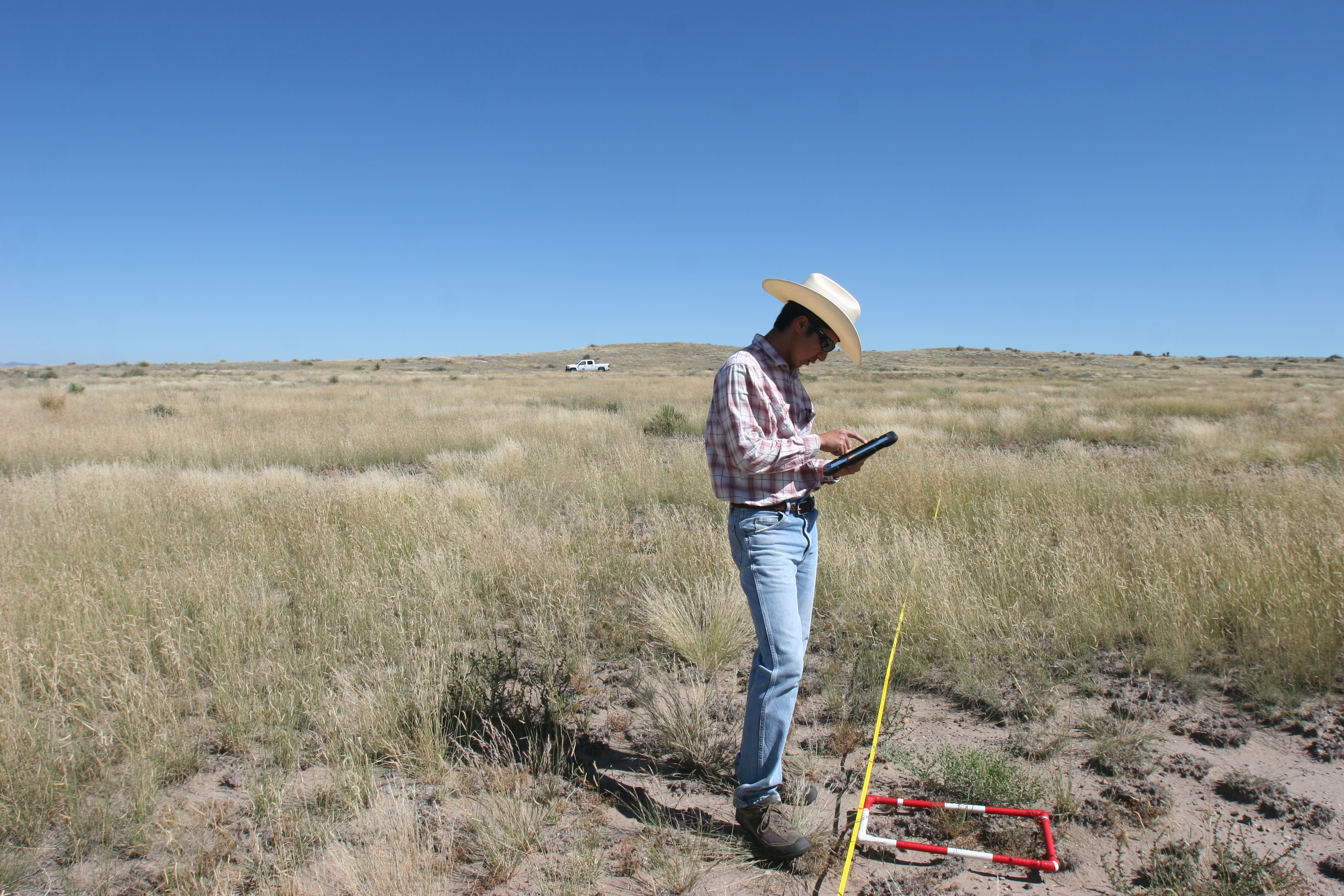
Ohnishi collects soil data at Mimms Unit (Photo by Nora Ohnishi)
Bacteria and archaea are single-celled microscopic organisms that are found practically everywhere—from deep-sea vents and arctic glaciers, to cattle intestines and human belly buttons. Many microbes belong to nature’s recycling crew; they break down dead plants and convert them into nutrients required by living plants. Microbes also help create a complex soil texture, which in turn allows seeds to take hold and more rainwater to soak into the ground. All of these functions make soil microbes essential members of a desert grassland ecosystem.
To determine which microbes populate Mimms Ranch, Ohnishi analyzed the microbial DNA in soil samples collected from several unburned, burned and intensely overgrazed sites. Then he used statistical analyses to compare these microbial communities before and after the summer rainy season in 2012. He also looked for correlations with the amount of plant cover, soil nutrients, and other soil characteristics at each study site.
In burned areas, Ohnishi found nearly half as much microbial DNA as in unburned areas, indicating soil microbes had been hit hard by the fire and drought. But microbial activity recovered after the summer rainy season at both burned and unburned sites. Ohnishi observed a corresponding increase in the amount of certain soil nutrients needed by grasses and other plants, which also bounced back after the summer rains.
Ohnishi was particularly amazed by the diversity of soil microbes he encountered. For example, one five-gram soil sample—the weight of a nickel—was home to around 400 types of bacteria.
“There’s so much diversity, and these microbes perform so many functions,” he said. “We have no clue what they all do yet.”
Understanding what each soil microbe does will be up to future researchers. For now, Ohnishi’s research demonstrates that these microbes are part of the recovery process after a devastating fire and drought. And he envisions his research contributing to a micro-ecosystem approach to land management, in which supporting microbial activity would be a way to improve rangeland health.
Bonnie Warnock, associate professor of range science at Sul Ross State University, directed Ohnishi’s research.
“Both the physical and biological health of the soil is critical to healthy ecosystems,” she said. “We tend to take the soil for granted and forget that it is, in a very real way, the base for all life.”