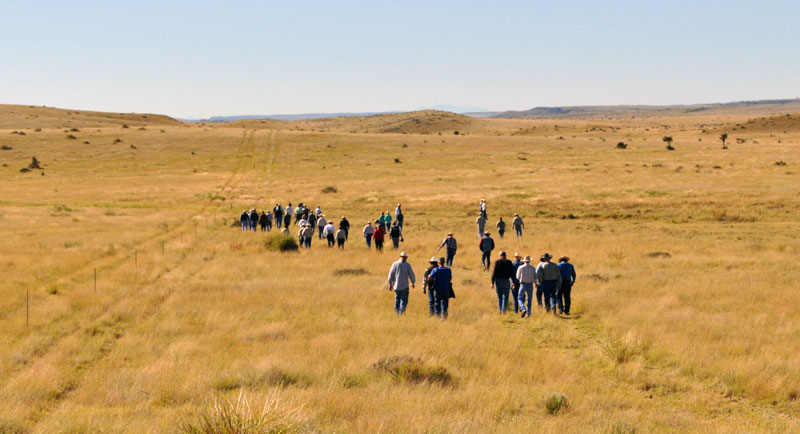
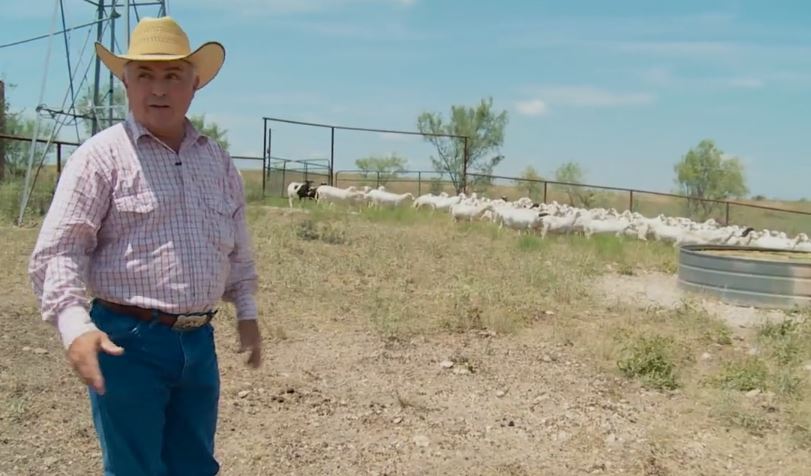
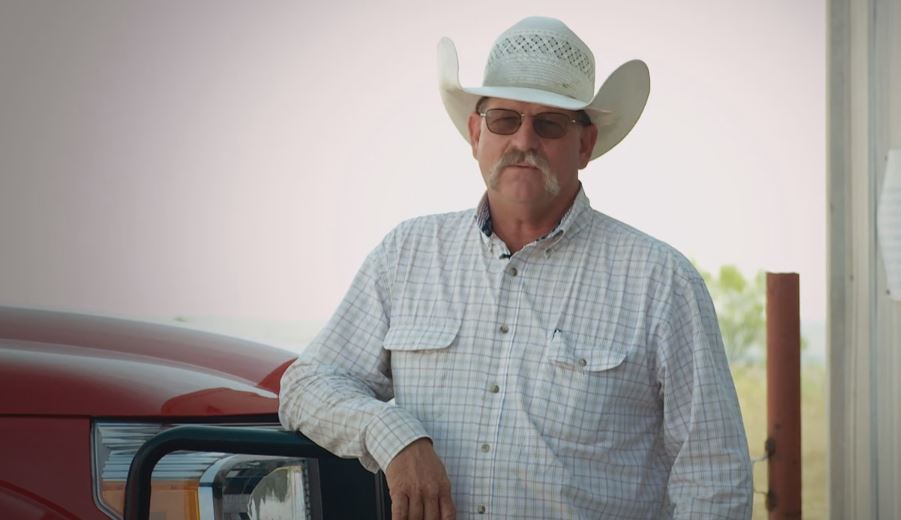
RFD TV’s Out on the Land episode about Dixon Ranches Bear Creek Unit can now be viewed online and includes interviews with foundation ranch managers Danny Parker and Robby Tuggle.
NEWS & EVENTS
Rainwater harvesting workshops in Alpine, Marfa
Join drylands permaculture designer and educator Brad Lancaster for “Beyond Rain Barrels” in Alpine and Marfa September 19-21.
Lancaster will give lectures about rainwater harvesting at the Granada Theater in Alpine at 7pm on Friday, Sept. 19 and at the Crowley Theater in Marfa at 7pm on Saturday, Sept. 20. Lectures will be followed by workshops at the Alpine Public Library from 8am – 2pm on Saturday, Sept. 20th, and at the Marfa International School from 9am – 3pm on Sunday, Sept. 21.
Space is limited in these free workshops. Reserve a spot by emailing bigbendrainwater@gmail.com.
A thoughtful defense of holistic management
Last week in The Guardian, L. Hunter Lovins offered a thoughtful defense of holistic management: “Why George Monbiot is wrong: grazing livestock can save the world.” Lovins was responding to George Monbiot’s previously published critique of Allan Savory’s 2013 TED Talk (“How to fight desertification and reverse climate change“).
“In his recent interview with Allan Savory, the high profile biologist and farmer who argues that properly managing grazing animals can counter climate chaos, George Monbiot reasonably asks for proof. Where I believe he strays into the unreasonable, is in asserting that there is none.
Savory’s argument, which counters popular conceptions, is that more livestock rather than fewer can help save the planet through a concept he calls “holistic management.” In brief, he contends that grazing livestock can reverse desertification and restore carbon to the soil, enhancing its biodiversity and countering climate change. Monbiot claims that this approach doesn’t work and in fact does more harm than good. But his assertions skip over the science and on the ground evidence that say otherwise.”
He cites research by Richard Teague, a Dixon Water Foundation advisory board member, “finding significant soil carbon sequestration from holistic range management practices.” He also mentions several examples of successful holistic management practitioners, as well as studies by soil microbiologist Dr. Elaine Ingham:
“Peer-reviewed research from Rodale [Institute] has shown how regenerative agriculture can sequester more carbon than humans are now emitting. Scientists, as well as dozens of farmers, ranchers and pastoralists from around the world, describe how they are increasing the health of their land, the carrying capacity of it, its biodiversity, and its profitability, all while preserving their culture and traditions…
…I’d invite [Monbiot] to come out on the land, see with his own eyes and learn from those who are healing grasslands while producing food, fibre and community prosperity.”
Josey Agroecology Institute in Lewisville Leader
On August 12, the Lewisville Leader featured the Josey Agroecology Institute at North Central Texas College, funded by a grant from the foundation.
Clint Josey (second from left), the Chairman of the Board of Directors of the Dixon Water Foundation, presents a check to NCTC officials to establish the Josey Institute of Agroecology. Also pictured is NCTC President Dr. Brent Wallace (left), NCTC Science and Math Initiatives Chair Dr. Lisa Bellows, and Dixon Water Foundation CEO Robert Potts.
Dixon funds agroecology institute at NCTC
GAINESVILLE―A new institute at North Central Texas College will promote sustainable agriculture and healthy food production.
The Josey Institute for Agroecology will conduct research and offer educational programs on sustainable ranching and farming for NCTC students, as well as land owners and the general public. The institute’s creation was funded through an $88,000 grant from the Dixon Water Foundation, which promotes healthy watersheds through sustainable land management and has two ranches in Cooke County.
“This institute will help train a new generation of land stewards to manage economically and ecologically sustainable ranches, which are so important to our state’s future,” said Robert J. Potts, president and CEO of the Dixon Water Foundation.
Receiving the foundation’s check on his first day as NCTC president, Dr. Brent Wallace said, “Service to the community is a vital part of our mission. The establishment of the Josey Institute at NCTC is going to allow us to explore some innovative approaches in serving our students, as well as the entire community, by including programs for planetary sustainability. We are extremely grateful for the monetary contribution, but even more honored to have the opportunity to work in partnership with the people at Dixon Water Foundation.”
Science professor Lisa Bellows will direct the institute. “This will be an exploratory year for the Josey Institute, so that we can define the needs of our community, organize our approach, and target the position of NCTC as a leader in agricultural ecology,” Bellows said.
The institute will serve as the new home of the Promoting Agriculture and Conservation Education (PACE) Project, an existing collaboration between the college and the Gainesville Independent School District. PACE students learn about sustainable ranching on a holistically managed property south of the Gainesville High School. Rotational and multi-species grazing are demonstrated on the property, which is owned by the school district and leased by the college. The Dixon Water Foundation has previously funded the PACE Project as well.
The PACE Project has offered several programs for agriculturalists in the past three years. Bellows said, “Internationally recognized soil microbiologist Dr. Elaine Ingham attracted over 180 visitors to our campus, and we provided soil micro training for over 100 participants this past year.”
Through the institute, Bellows will be teaching a Sustainable Agriculture course this fall, in which Whole Land Management will be the focus. The institute has also scheduled several programs for the general public in the coming year.
The Dixon Water Foundation’s mission is promoting healthy watersheds through sustainable land management. To that end, the foundation demonstrates sustainable land management practices at its four ranches in north and west Texas. In Cooke County, the foundation’s Leo ranch is the site of the new Betty and Clint Josey Pavilion, which aims to be Texas’ first Living Building, the highest standard in sustainable building. The foundation also hosts educational programs, partners with researchers, and funds grants for projects that further its mission.
Cattle could help meet EPA emissions target
Russ Conser’s letter to the editor, “Research could pay off“, in the July 10 Houston Chronicle suggests holistic cattle grazing could help Texas meet new Environmental Protection Agency emissions guidelines, citing research by Dixon Water Foundation advisory board member Richard Teague. His letter brings up some excellent points and is well worth reading. Here’s an excerpt:
Research by Dr. Richard Teague at Texas A&M University on ranches in north central Texas indicates the ability to take up roughly 1.2 tons of carbon per acre in ranch land soils simply by changing how cattle are grazed on the land. More research is needed, but if the same numbers held up on average elsewhere in the state, implementing these methods on just 3 million acres, or just 1.7 percent of the land area of Texas (172 million acres), would offset 10 percent of the EPA emissions target given to Texas.
These techniques also lead to higher rancher productivity, lower costs, increased water infiltration and holding capacity, and increased biodiversity. Implementation would also lead to better drought resilience, less flooding, better hunting habitat and enhanced rural economies.
Texas, still the largest producer of cattle in the country, would be smart to consider implementation of novel grazing practices as part of its EPA response plan. We would truly be a leader in doing so.
Water conservation featured in Lands of Texas
As Texas’s water supplies become increasingly scarce, good land management can play a critical role in protecting watersheds. This was the message of a recent Dallas Morning News opinion piece, “Holistic ranching essential as demand for water grows.” It was also the subject of a recent article in Lands of Texas magazine, which highlights how Dixon Ranches use holistic management to conserve water.
HMI Open Gates at Dixon Ranches this fall
Holistic Management International will host an Open Gate at Mimms Unit on September 13, 2014 and at Leo Unit on November 8, 2014. These educational events offer participants an opportunity to see from the ground up how producers are using Holistic Management to better manage risk, make better decisions, and reap the benefits of sustainable, profitable ranching. Visit HMI’s website for more information.
Playa Field Day on June 24
The Ogallala Commons and Dixon Water Foundation are hosting a Playa Field Day on Tuesday, June 24, near Nazareth.
The event will be from 8:30 a.m. to 1 p.m. beginning at the Home Mercantile Building, 101 Second St., in Nazareth. Texas Tech researchers will lead the tour of two playas, and those attending should dress appropriately and bring bug spray. There will be opportunities to wade in ankle-deep water to observe species like tadpoles, fairy shrimp, dragonflies and damselflies. The second playa is enrolled in the USDA-NRCS Wetlands Reserve Program and demonstrates improvements conservation efforts make, according to a news release.
There is a $10 fee for a sandwich lunch and refreshments. RSVP to Darryl Birkenfeld at 806-945-2255 to ensure an accurate lunch count.
Viewing area at Mimms complete
Soon visitors to our Mimms Unit will be able to enjoy 360-degree views of the Marfa grasslands and surrounding mountains from this new hilltop viewing area, designed by Marfa’s Joey Benton. The 2.5-mile overlook trail leading to the hill will have signs with more information about sustainable ranching, grasslands, and watershed health. Stay tuned for information about a grand opening of this trail and viewing area later this summer.